 Toon Tone
Color Guessing Game: How It Works and Why Toon Tone Is Different
A color guessing game asks you to produce a color answer and then compares it with a hidden target. Toon Tone brings that idea into cartoon and anime color memory.
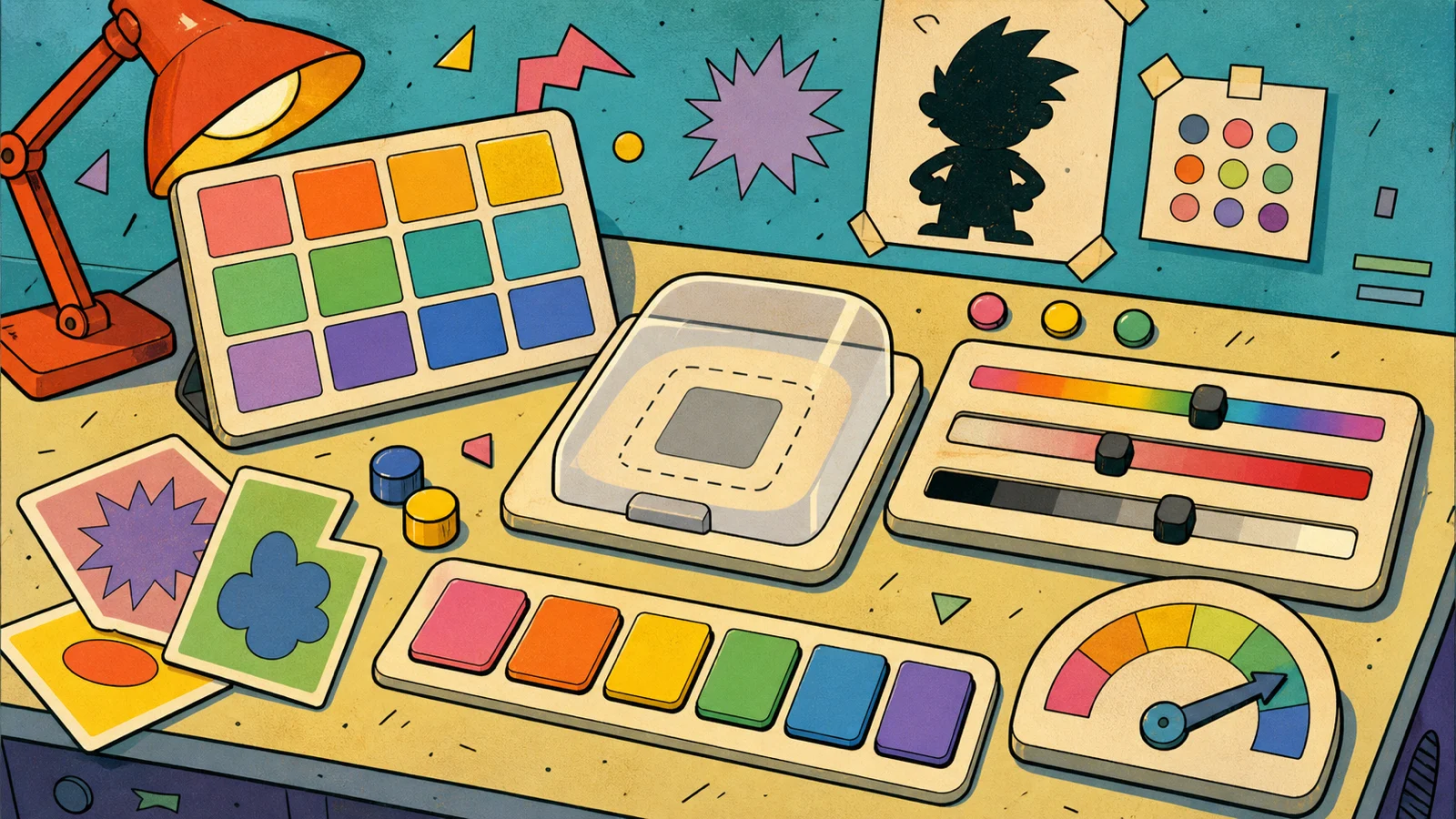
What is a color guessing game?
A color guessing game is an interactive challenge where color accuracy is the main goal. The player might choose a swatch, sort a gradient, name a shade, mix a value with sliders, or rebuild a color from memory.
The answer is usually hidden, partially disguised, or separated from the player until a decision is made. That single rule creates the tension: you must commit before the game tells you whether your eye was right.
The three parts every color guessing game needs
1. A target color
The target can come from a curated palette, a generated hex value, a real image, a brand color, or an illustrated character. The better the target, the better the game feels. Random colors are easy to generate but often meaningless. Familiar colors are harder to source but more memorable.
2. A guessing interface
Games usually let players answer through multiple-choice swatches, a color picker, typed color names, RGB controls, HSB controls, or drag-and-drop sorting. Each interface trains a different skill. Multiple choice is fast; sliders are deeper; gradient sorting is more about visual comparison than recall.
3. A scoring rule
The score converts the distance between the player's guess and the target into feedback. A good score should feel fair. If two colors look close, the score should be high. If they look visibly different, the score should drop in a way players can understand.
Common types of color guessing games
- Swatch choice games show several colors and ask you to pick the closest answer.
- Gradient sorting games ask you to arrange colors into a smooth sequence.
- Hex code puzzles turn color into a daily word-game style challenge.
- Name-the-color quizzes test vocabulary as much as visual perception.
- Memory color games hide the answer and ask you to rebuild a shade you already know.
Toon Tone belongs to the memory category. It is not only asking whether your eye can compare two colors. It asks whether your brain can retrieve a cartoon color when the original is not visible.
Why memory-based color guessing is harder
When two swatches sit side by side, your visual system can compare them quickly. When the target is missing, you rely on memory. That memory is useful but imperfect: familiar objects often become cleaner, brighter, warmer, or more saturated in your head.
This is why a famous character can still be difficult. You may know the character instantly and still miss the exact tone of their hair, shirt, cheeks, or eyes. The gap between recognition and precision is the game.
Why Toon Tone uses HSB sliders
HSB stands for hue, saturation, and brightness. It is a practical model for a casual color guessing game because it mirrors the decisions players make naturally. First they choose the color family. Then they decide how intense it should be. Then they decide how light or dark it feels.
RGB is useful for screens and code, but most players do not think in red, green, and blue channel values. Toon Tone's HSB sliders let players reason in plain visual terms: warmer, duller, brighter, darker, cleaner, softer.
How Toon Tone fits the genre
Toon Tone combines a color guessing game with pop culture memory. Each prompt names a character and a target part, then asks you to rebuild the color without sampling it from the image. A five-round session gives enough attempts to create a meaningful average without turning the game into homework.
The cartoon angle matters because illustrated characters often have deliberate base colors. Unlike a photograph, where lighting can create dozens of possible answers, a cartoon design usually has a clear intended shade. That makes scoring feel cleaner and more fair.
Who should play color guessing games?
Color games are useful for designers, artists, students, animation fans, and anyone who enjoys small daily challenges. They can sharpen attention to hue and brightness, but they are also simply satisfying: a good guess feels like remembering something your eyes knew before your words did.
Frequently asked questions
What is a color guessing game in simple terms?
It is a game where you make a color answer and the game compares it with a correct or hidden target.
Is Toon Tone a color guessing game?
Yes. Toon Tone is a memory-based color guessing game built around cartoon and anime character colors.
What is the difference between color guessing and color matching?
Color matching usually shows the target while you adjust your answer. Color guessing often hides the target until after you commit.
Are color guessing games good for beginners?
Yes. Multiple-choice games are the easiest, while slider-based games like Toon Tone give more control and better feedback.